The fitness industry is in flux, we aren’t sure where we are heading and sometimes not so sure where we currently exist! You see, the fitness industry is at a cross roads, we have all this wonderful new information and yet, we can’t quite say the classic methods are outdated or less practical than they once were.
We get coaches that are scared what these new training tools and implements do to their programs and question are they innovative enough to change with the times and find how to integrate all these wonderful new concepts to programs they have been doing for years! On the other side we have coaches that embrace anything “hardcore” and without much understanding begin to randomly apply any new training tool.
It seems that we see glimpses of such changes here and there. Recently one of our industry’s more respected coaches, Bret Contreras, wrote an article called “Can’t Turn This!: A Simple Plan for Rotary Stability” (Click Here to Read the Article). That may seem a bit overwhelming in the terminology, but the premise is quite simple. Your joints require stability in all planes of motion (there are three: sagittal, frontal, and transverse) but the more stable our exercises the less they get trained in all three. That is why machine training doesn’t transfer to everyday or sporting activities very well.
What most people don’t realize and what I have been trying to convey, is that this is not limited to just machines. In his article Bret talks about working with a high level lifter who can put up 400 pounds in the good morning, but couldn’t perform a single bodyweight Bulgarian split squat. Many years ago I might have said “BOGUS”!, but more and more I am finding similar issues with many athletes and lifters. Why?
Our strength training programs can’t move away from the idea that these big weight room numbers don’t necessarily correlate with better performance or health. In fact, an overemphasize of the “classic” lifts can create an environment somewhat similar to the problems that machines cause. In more stable positions we are able to stabilize much easier and the deeper stabilizer muscles work less and less. We lose a lot of these key athletic concepts of stability and movement by the overemphasis of what a lot of coaches call “the basics”.
It would seem so easy just to focus on squats, deadlifts, and some presses, gosh, wouldn’t training and performance just be so easy?! However, we would miss so many benefits and find stagnation occur very quickly. Why is this “stability” thing so important? Here are some of the benefits Bret listed, just to name a few:
“It will assist in transmitting rotational forces efficiently, thereby eliminating energy leaks that slow you down.
It will increase eccentric, isometric, and concentric rotary power which is needed in sprinting, throwing, swinging, kicking, and striking.
It will prevent certain joints form incurring torsional stresses, which can wreak havoc on soft tissue and lead to pain or injury.”
Here is the problem though, most people don’t know how to progressively teach people these concepts. It is either lunging, step-ups, and/or single leg squats, which are all great drills but often are far too difficult for most people. I do disagree with Bret when he says, “Standing on one leg isn’t problematic for most people as the task isn’t very challenging for the hip rotary stability mechanism.” In fact, take most people just slightly out of their stable basis and things get more than a bit crazy!
Even if we get people to these unstable positions, our standard strength training tools do not allow for many options in creating loading patterns conducive to achieving our goal of total body strength and stability. Rotary stability is not just standing on one leg or using one arm in lifts, it is understanding how to integrate the entire body to resist certain motions and allow others. It is learning how to utilize the RIGHT tool to provide different loading patterns that actually can train our stability and strength.
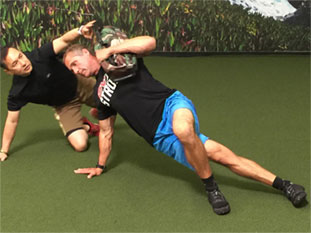
For those of you that are sitting there rolling your eyes at the idea that just doing these simple lunges and some offset presses are enough, let me tell you that you haven’t scraped the surface of where this type of training can take you in training! I have seen accomplished lifters hit new personal bests and others resolve nagging aches and pains by using such concepts. However, the key is progression! That is why today’s training video focuses on the first two levels of our techniques in providing rotary training. I DARE you to actually take the time and prioritize some of these movements in your own training!
NOTE: YES, the audio cuts out the last minute or so, we are trying to rectify that for the future. The half kneeling Shoulder to Shoulder Press is a great way of building towards more advanced unstable positions. It is stable enough where we can focus on the quality of the press, but the instability in this position can demonstrate early control factors that will in the lift. Stay tuned for more!
Want to Learn More About These Innovative Techniques? Don’t Miss Out on Our Advanced Performance Strength Seminar June 18th!: Find out More HERE
Unlocking Your Strength Potential is a post from: Sandbag Training
Related posts:
- The Experts Talk on Low Back Health I feel compelled to start today’s post with a…
- R.I.P. the Barbell Part 2! Last week I wrote a post that may have gotten…
- Sandbag Training For Athletes Part 1 This is an article that will be posting on a…
Related posts brought to you by Yet Another Related Posts Plugin.
Henkin Fitness Systems